Tu carrito de compras esta vacío!
Categorías
Destacado
Google Translate
Agua desmineralizada

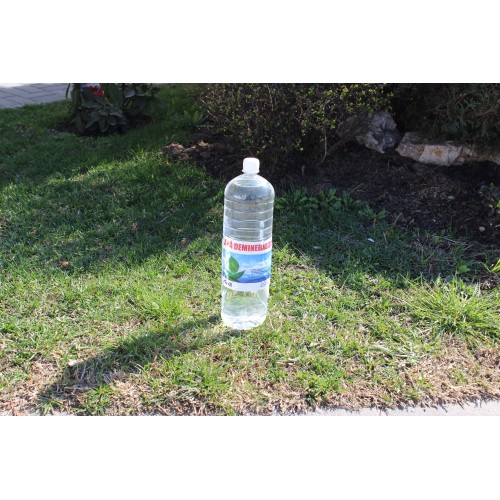
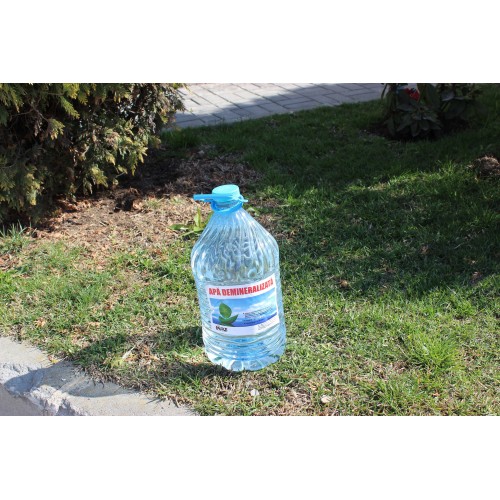
Código del producto: C1525608
Momento de la Entrega: 15 days
Disponibilidad: 1000000
Momento de la Entrega: 15 days
Disponibilidad: 1000000
Precio: 0.24€
/litre
Precio Con Impuesto: 0.28€ /litre
Precio Con Impuesto: 0.28€ /litre
RRP: 0.34€ /litre
Cantidad:
- O -
Agregar a la lista de Deseos
Comparar
Comparar
Este producto tiene una cantidad mínima de 1000

Distilled or demineralized water
Distilled water (demineralised water) is water with a TDS of less than 2 ppm. In other words, the distilled water has a concentration of H 2 O molecules close to 99.9998%.
Untreated water will never have this purity because its circuit by nature it is contaminated with various mineral compounds (calcium, magnesium, etc.) or organic (solvents, hydrocarbons) derived from wastewater.
Distilled water purity is determined by measuring electrical resistivity expressed in ohms [Ω]. The electrical resistivity is bigger distilled water is purer.
A resistivity of 18 MΩ is typical of ultrapure demineralized water. Plain water has a resistivity of 2000 Ω. Sea water has a resistivity of 20 Ω.
Although it has a pH between 6 and 7.5 distilled water it is very aggressive in terms of corrosive action.
Installation for obtaining distilled water, demineralized water
Reverse osmosis involves filtering water through a membrane using osmotic pressure.
Distillation involves heating the water to boiling point, vaporization and condensation thus obtaining distilled water.
Deionization water involves removing contaminants using two electrodes connected to a power source. The salts of the cations present in the water dissociates (+) and anion (-).
Sodium chloride - NaCl (table salt) dissociates cation of sodium (Na +) and chloride anions (Cl). The positive electrode will attract anions (-) while the negative electrode will attract cations (+). Deionization can not be extracted by organic compounds.
None of the three procedures listed US not produce ultra pure demineralized water. Therefore, they are combined: distillation or deionization + + reverse osmosis reverse osmosis.
Demineralized water is mainly used in the pharmaceutical industry, the cosmetics industry and electronics industry (production of integrated circuits).
Demineralized water is used in power plants to generate steam and drive turbines needed.
We guarantee that all products purchased on our site are original and comply with the laws of production and distribution
Escribe una opinión
Tu nombre:Tu opinión: Nota: HTML no es traducible!
Puntuación: Malo Bueno
Introduce el código en la casilla inferior:


iDepozit
Str. Balciului, Nr 166, Valcea
 : iDepozit.ro
 : iDepozit
+04 (0)34 081 4449
+04 (0)770 666 524
RO 34871297
Str. Balciului, Nr 166, Valcea
: iDepozit.ro: iDepozit+04 (0)34 081 4449
+04 (0)770 666 524
RO 34871297

Creado por iPlus.ro